Automotoplus Background
Blog

Passing the Category B practical driving test in Switzerland: the

From registration to the examiner's verdict: steps, deadlines, costs in CHF and pitfalls to avoid in order to pass your Category B driving test first time…

Automotoplus - Passing the Category B practical driving test in Switzerland: the

1. Check your prerequisites before paying anything

Léo is 19. He is an apprentice in Lausanne. He turns up for the practical test one Tuesday morning, full of confidence. At the third junction, he slows down at a stop sign, does not come to a complete halt and drives off. The examiner notes the fault and the test ends. The result: the fee is lost, a new registration has to be paid for, and there are several weeks of waiting. Three hundred francs and a month of patience for a wheel that never quite stopped turning.
To avoid this scenario, start at the beginning: the prerequisites. No complete file, no test.
Here is what you need:
  • A valid learner driver's permit, obtained after the eyesight test and the first-aid awareness course (generally about ten hours).
  • The road traffic awareness course, often simply called the awareness course, whose duration and venue depend on the approved provider.
  • A period of at least one year between the issue of the learner's permit and the practical test.
This one-year period is set by the Ordinance on Admission to Road Traffic (OAC). It is not negotiable. Under the OAC, the learner driver's permit must have been held for at least twelve months before taking the Category B practical test: there is no point booking an earlier date.
My firm view: never treat these courses as a formality to be rushed through. You may one day use first aid on the road, and the awareness course teaches you to anticipate the mistakes that examiners penalise most. The exact procedures and the certificates to provide are set out on the website of your cantonal road traffic office.

2. Registering with the road traffic office and paying the fees

Registration is made with the road traffic office of your canton of residence. Vaud, Geneva, Fribourg, Neuchâtel, Valais, Jura: each canton has its own form, its own portal and its own fee schedule. Amounts vary from one canton to another, and I will not invent a single figure. Check the official tariff of your cantonal office before paying.
What you need to remember is the logic of the costs:
  • The test fee is due at every attempt. A failure means a new fee.
  • The test is booked online or by post, depending on the canton, with a waiting time that can range from a few weeks to several months in busy periods.
  • A late cancellation may result in the loss of the fee. Read the cancellation conditions before confirming.
Workshop advice: book your date as soon as you have 20 hours of driving under your belt, not when you feel ready. The waiting time works in your favour, as it gives you time to polish your skills. Waiting for the perfect feeling of mastery means losing weeks for nothing.
If you are unsure about the procedure, we have set out the full process in our guide to the practical car test in French-speaking Switzerland in 6 steps, which is useful for comparing the procedures between cantons.

3. Preparing the test vehicle: a single tyre can cancel everything

The test vehicle is the first judge. There are two options: your driving school's car, or a private car. In both cases, the examiner inspects it before getting in.
A test car with a tyre worn down to the legal limit? The examiner cancels before you have even started the engine, and the fee remains due. The legal minimum tread depth for tyres is 1.6 mm. Aim for much more, to be safe.
If you use a private car, check point by point:
  • Third-party liability insurance in force and the certificate to hand.
  • Motorway vignette affixed, even if the route does not use the motorway.
  • Roadworthiness inspection up to date, with no defects reported.
  • Tyres in good condition, correct pressure, no uneven wear.
  • Lights, indicators, brake lights, wipers, brakes and mirrors all working.
  • Number plates clean and legible, and the car tidy inside.
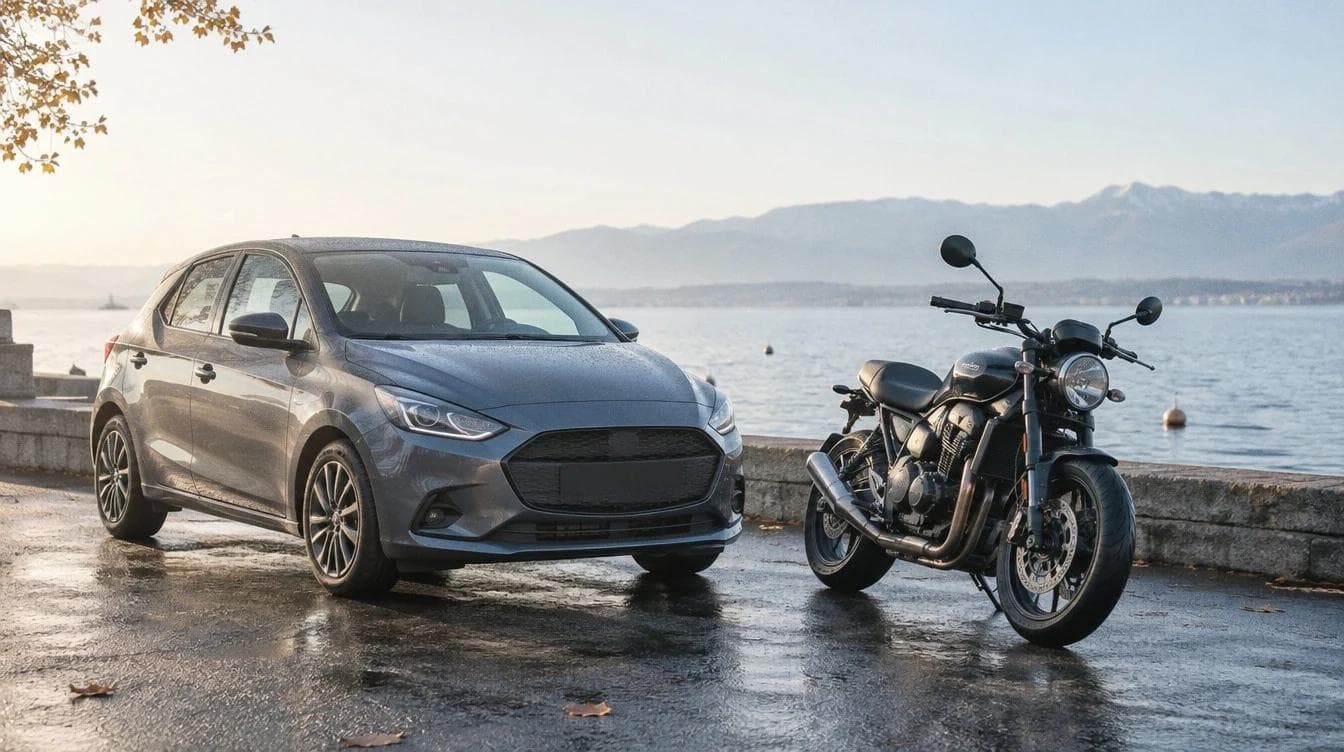
The simplest option: take the driving school's car. It is already compliant, fitted with the dual controls required, and the instructor knows how it responds. For a candidate paying out of their own pocket, it is the least risky option.

4. Choosing your driving hours: 20 to 30 is a useful minimum

How many hours before taking the test? The law sets no minimum for the Category B licence in Switzerland. But practical experience speaks clearly.
Aim for 20 to 30 hours of driving with your instructor before taking the test: below that, the failure rate climbs quickly on stop signs and priority to the right.
The price of a driving lesson varies according to the canton and the driving school. In French-speaking Switzerland, expect generally between CHF 90 and CHF 110 for a 50-minute lesson, but ask your school for the exact rate before committing. This is an indicative range, not a promise.
The calculation is quickly made: 25 hours at CHF 100 comes to CHF 2'500. Add the test fee, the compulsory courses and, sometimes, the hire of the car on the day. The total budget climbs. My opinion: saving on hours only to lose an extra test fee afterwards is a false economy. A second attempt costs more than three more hours with a good instructor.
How should you split these hours? Alternate:
  • Hours in dense urban traffic (priority, stop signs, 30 km/h zones, pedestrians).
  • Hours outside built-up areas (overtaking, speed adjustment, joining and leaving roads).
  • Sessions dedicated to manoeuvres (parallel parking, U-turn, reversing).
  • At least one full test simulation, with an instructor playing the role of the examiner.
25 driving hours (approx. CHF 100 per 50-minute lesson; range CHF 90 to 110)

Amount

CHF 2'500

Share

n/a (incomplete total, other items not quantified)

Test fee (due at each attempt, schedule varies by canton)

Amount

Not quantified (see the cantonal road traffic office tariff)

Share

n/a

Compulsory courses (first aid, road traffic awareness)

Amount

Not quantified (varies by approved provider)

Share

n/a

Possible hire of the car on the day

Amount

Not quantified

Share

n/a

Second attempt (Léo's example: new test fee + new registration)

Amount

approx. CHF 300

Share

n/a

Comparison: 3 extra driving hours (3 x approx. CHF 100)

Amount

approx. CHF 300

Share

n/a

Total

Amount

More than CHF 2'500 before test fee, compulsory courses and possible vehicle hire

Share

100 %

A failed test costs more than three extra hours of driving: the real cost of the licence exceeds CHF 2'500 before the fee

Key takeaway

The 25 driving hours already weigh in at around CHF 2'500; other costs not quantified in the article are added (test fee, courses, car on the day), and failing the test costs around CHF 300, as much as 3 extra hours of driving.
Source: Article "Practical driving test"; fee schedule: road traffic office of the canton of residence; one-year period between learner's permit and test: OAC

5. Test day: duration, route and what the examiner marks

The Category B practical test lasts about one hour in all, including roughly forty minutes of actual driving. The route is set by the cantonal examination office and mixes several types of road.
What you will encounter:
  • Urban driving: junctions, roundabouts, pedestrian crossings, priority rules, 30 km/h zones.
  • Roads outside built-up areas: appropriate speed, safe distances, overtaking.
  • Manoeuvres requested: parallel or bay parking, U-turn, reversing.
  • Sometimes a stretch of motorway or semi-motorway, depending on the region.
The examiner is not looking for perfection. They are looking for a safe driver who anticipates, observes and respects the rules. Safety is marked above all: checking blind spots, respecting priority, adapting speed, behaviour towards vulnerable road users.
One serious fault is enough to end the test: a stop sign not respected, priority refused, endangering a pedestrian. The verdict follows, with explanations.
The legal basis governing admission to driving is the Federal Road Traffic Act (LCR) and its implementing ordinance. Above all, remember this: the examiner applies the law, not their mood. Arrive rested, with your identity documents, your learner's permit and your glasses if you wear them. Without your learner's permit on you, there is no test.
1. Obtain the learner's permit

Timeframe

Beforehand (before the 12-month period)

Detail

Eyesight test and first-aid course (generally about ten hours). Blocking point: incomplete file, no test. (Candidate / approved provider)

2. Attend the road traffic awareness course

Timeframe

Duration and venue depend on the approved provider

Detail

Compulsory course that teaches you to anticipate the mistakes examiners penalise most. Blocking point: incomplete file without the certificate. (Approved provider)

3. Observe the minimum period between learner's permit and test

Timeframe

Minimum 12 months (OAC)

Detail

The learner's permit must have been held for at least twelve months before the Category B practical test. Blocking point: period not met, no point booking an earlier date. (Candidate (OAC rule))

4. Register with the road traffic office and pay the fee

Timeframe

Booking from 20 driving hours

Detail

Registration with the cantonal office of your place of residence; amount according to the cantonal tariff, fee due at each attempt. Blocking point: late cancellation = fee lost. (Cantonal road traffic office)

5. Check the test vehicle

Timeframe

Before test day

Detail

Tyres with a minimum tread depth of 1.6 mm, third-party liability insurance, vignette, roadworthiness inspection, lighting, dual controls if private car. Blocking point: non-compliant vehicle, the examiner cancels before starting and the fee remains due. (Candidate / driving school)

Four steps in the right order, and a single omission is enough to lose your test fee

Key takeaway

A complete file, the 12-month period respected and a compliant vehicle: without these three conditions, the test fee is lost and you have to start all over again.
Source: Ordinance on Admission to Road Traffic (OAC) — fedlex.admin.ch; cantonal road traffic office

6. After the test: probationary licence, course and resit in case

If the examiner passes you, you receive a probationary driving licence valid for three years. During this period, tolerance is almost nil: one serious offence, and the licence may be withdrawn with the probationary period extended to four years, or even the probationary licence cancelled.
You must also attend the further training course, namely two days of additional training, to be completed within a set period after obtaining the probationary licence. Do not put it off: if you do not do it in time, the probationary licence may not be converted into a definitive licence. Fees and dates are available from the approved providers in your canton.
And in case of failure? You can retake the test, but not the next day. A waiting period applies before the resit, set by the road traffic office of your canton. You pay the fee again and, very often, you rebook driving hours to correct the fault pointed out by the examiner.
The right reflex after a failure: ask the examiner, the instructor or the report what was penalised. Work on that precise point during your next hours. Léo, our Lausanne apprentice, worked solely on his stops for three sessions. He passed the next time.

Pitfalls to avoid: the mistakes that cost you the test

Here are the faults that come up most often, with the corrective action beside each:
  • Stop sign not respected: the wheel must come to a complete halt, before the line. Count "one, two" in your head before moving off.
  • Priority to the right forgotten: at every junction without signage, look right before pulling out, even if it means slowing right down.
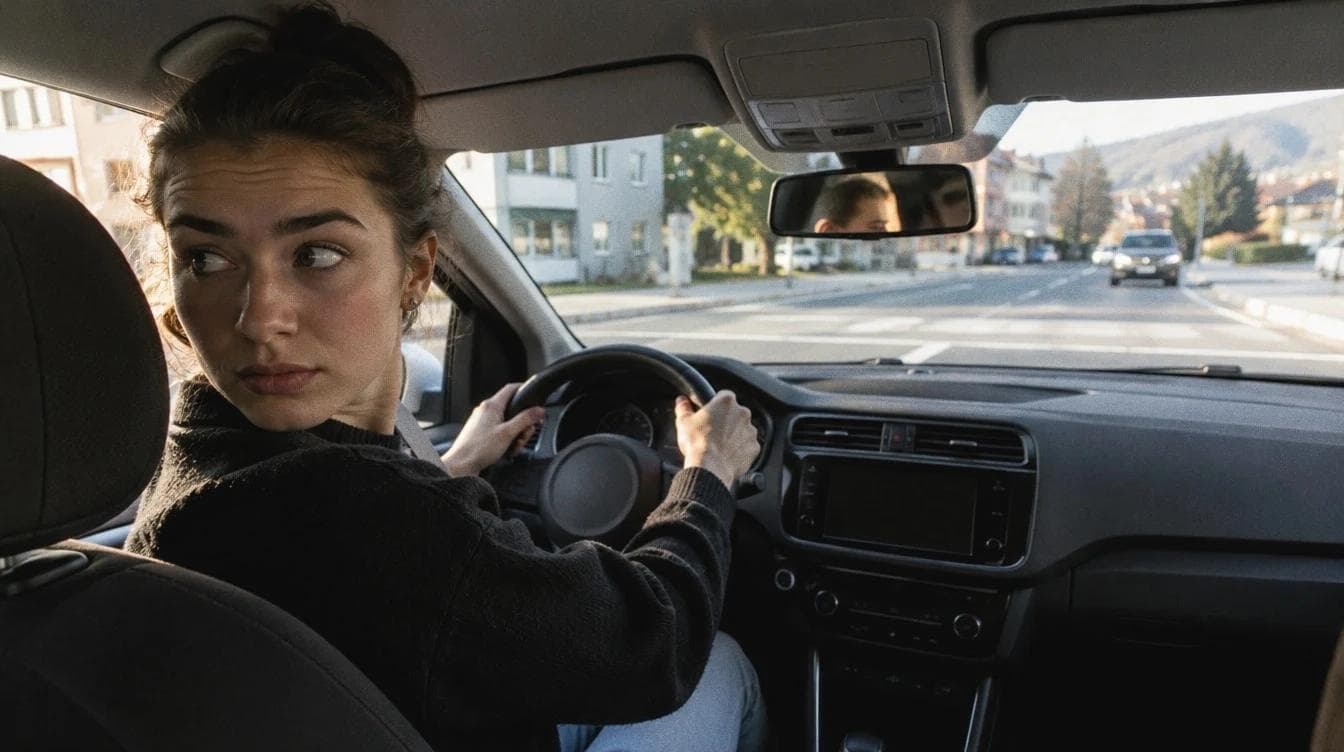
  • Blind-spot check omitted: before every change of direction or lane, turn your head, not just your eyes towards the mirror.
  • Speed poorly adjusted in a 30 km/h zone: drive at 30 km/h, not 38. The examiner spots the slightest excess.
  • Nerves when parallel parking: breathe, take your time. A parking manoeuvre completed in three moves is better than a botched one done at speed.
  • Test vehicle refused for a technical defect: non-compliant tyres, lighting or paperwork, and the examiner cancels before departure. Check everything the day before.

Your checklist for this week

Three concrete actions, to be completed before Sunday:
1. Book your test date with your canton's road traffic office, checking the fee and cancellation conditions in the official tariff. 2. Schedule your last driving hours with your instructor, aiming for 20 to 30 hours in total, including one full test simulation. 3. Check the insurance and the condition of the test vehicle: certificate, vignette, tyres, lighting, roadworthiness inspection.
Then consult the website of your cantonal road traffic office for up-to-date forms, fees and waiting times. Amounts and procedures vary from one canton to another: only the official source is authoritative. Safe driving, and come to a full stop at that stop sign.
"The information presented in this article is provided for information purposes only and does not constitute legal advice in any way; as the requirements for the practical driving test may change, we invite you to consult the competent cantonal authorities or a qualified professional."

FAQ

You must observe a minimum period of one year from the issue of the learner driver's permit before you can take the Category B practical test. This period is set by the Ordinance on Admission to Road Traffic.

The test fee varies from one canton to another and must be paid at every attempt. Consult the official fee schedule of your canton's road traffic office to find out the exact amount before registering.

The law sets no minimum for Category B, but 20 to 30 hours of preparation with an instructor is a solid benchmark. The price of an hour varies according to the driving school and the canton, so ask for the exact rate.

You can retake it after a waiting period set by the cantonal road traffic office. You must pay the test fee again and, often, take a few more driving hours to correct the fault that was penalised.

After passing, you obtain a three-year probationary licence. You must attend the further training course, two days of additional training, within the set period in order to obtain the definitive licence.

Automotoplus Background
A question about your licence or your vehicle?

Our team advises you on maintenance, insurance and the choice of test vehicle. Contact us to prepare calmly for your test with the examiner.

Author image

AutoMotoplus

Passing the Category B practical driving test in Switzerland: the