Automotoplus Background
Blog

Practical car driving test in French-speaking Switzerland: 6 steps to

Geneva, Tuesday 8:15 a.m.: the SAN examiner notes every glance. Here are the 6 steps to pass the category B practical test first time.

Automotoplus - Practical car driving test in French-speaking Switzerland: 6 steps to

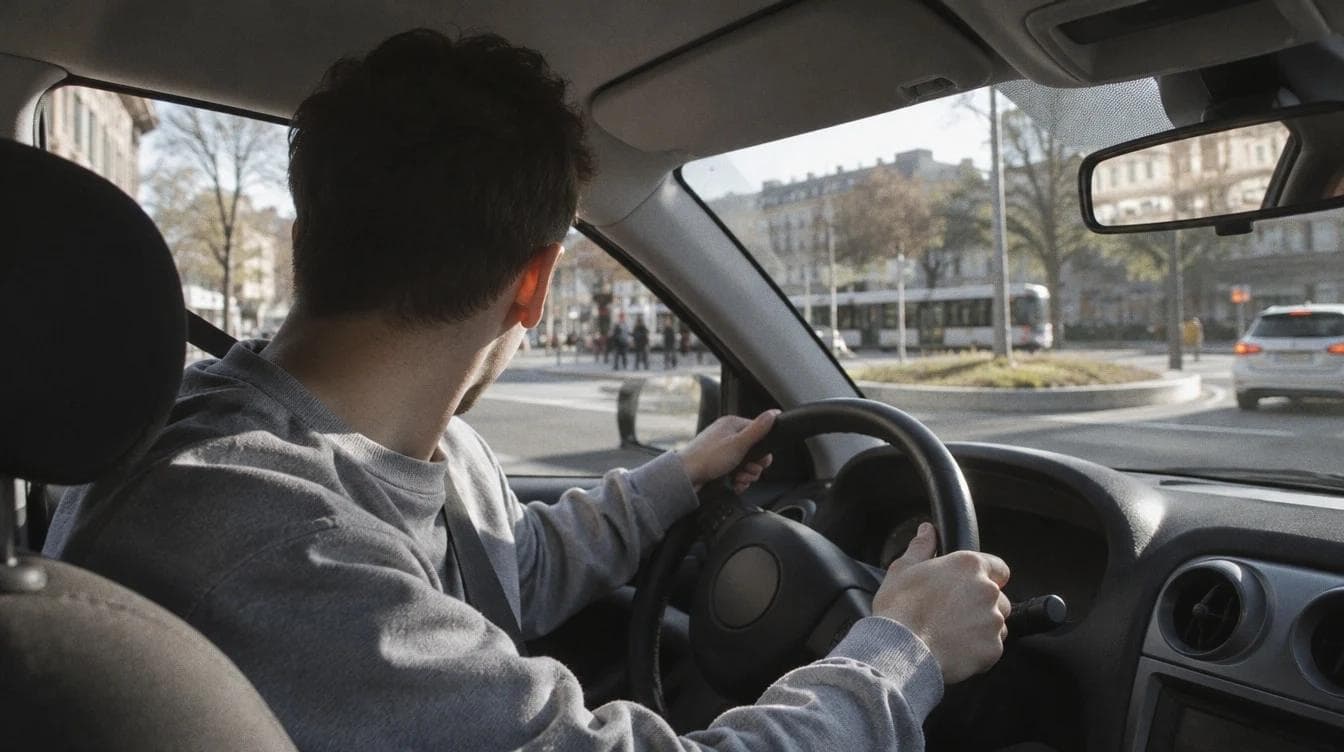
Tuesday 8:15 a.m., the Plainpalais roundabout

Tuesday morning, 8:15 a.m. The candidate is 18, the indicator is ticking, and he is approaching the Plainpalais roundabout. Beside him, the examiner from the Service des automobiles et de la navigation (SAN, the Geneva motor vehicle and navigation office) says nothing. He turns his head slightly, then lowers his eyes to his tablet. He has just noted that the candidate did not check over his shoulder before pulling back into lane.
Twenty lessons do not simulate this. The test lasts about 45 minutes, with no comments and no indulgence for small habits.
This article follows the route in order, from the learner's permit to the exit of the test centre. It covers category B only. What falls under federal law applies throughout Switzerland. Fees, waiting times and time slots vary from canton to canton: Geneva serves here as a common thread, not as a model for the whole of French-speaking Switzerland.
According to the Ordinance on the admission of persons and vehicles to road traffic (OAC), the category B driving licence can be obtained from the age of 18, after passing a theory test and a practical test.

1. Learner's permit and theory test

Everything starts with the learner's permit. You apply for it from the cantonal motor vehicle office, here the SAN in Geneva. The file includes a photo, an eyesight test and the certificate of the first-aid course (see step 2).
As for cost, expect around CHF 60 for the learner's permit at cantonal level. This amount varies: check it on the canton's official page before travelling. Geneva details test registration on ge.ch.
The category B theory test is taken on a computer, at the canton's test centre. It covers traffic rules, road signs and behaviour behind the wheel. The legal bases are the Road Traffic Act (LCR) and the Ordinance on road traffic rules (OCR).
Theory is not the subject of this article. If you are starting from scratch, our guide to the theory test and the Swiss highway code details the content and typical questions. Here, we assume the theory is already behind you.
Federal law sets one precise point: a category B learner driver may drive only under the supervision of an accompanying person who has held a licence for at least three years. That is what the OAC says, not the canton.
1. Learner's permit

Timing

From the age of 18

Detail

File submitted to the SAN: photo, eyesight test and first-aid certificate. About CHF 60 at cantonal level. Theory test passed beforehand. (SAN (cantonal motor vehicle office))

2. First-aid course (samaritans)

Timing

Before the practical test

Detail

Compulsory certificate, attached to the learner's permit file. Allow CHF 100 to CHF 150 depending on the organiser. (Recognised samaritans section)

3. Supervised driving and driving school

Timing

About 20 lessons on average (no legal minimum)

Detail

45-minute lesson at CHF 90 to CHF 110. Accompanying person who has held a licence for at least 3 years. (Accompanying person and driving school)

4. Booking the test and preparing the vehicle

Timing

Waiting times vary by canton; test of about 45 min

Detail

Booking via the SAN (ge.ch). Documents to present on the day: learner's permit, identity document, first-aid certificate if requested, proof of payment of fees. Roadworthy vehicle (tyres, brakes, mirrors, plates, third-party liability insurance). (SAN and candidate)

Four steps separate the learner's permit from the test room, and two of them are settled before you have touched a steering wheel

Key takeaway

The learner's permit and the first-aid course are settled before the first turn of the wheel; the real room for manoeuvre comes afterwards, in supervised driving and at the driving school, then when booking with the SAN.
Source: OAC (Ordinance on the admission of persons and vehicles to road traffic) — fedlex.admin.ch; SAN Geneva — ge.ch. Indicative fees, varying by canton (Geneva as a common thread).

2. First-aid awareness course

The so-called "samaritans" course is compulsory before the practical test. It is taken with a recognised organisation, often a local samaritans section. You leave with a certificate, to be attached to the learner's permit file.
The format depends on the organiser. So does the price: it is generally between CHF 100 and CHF 150 depending on the provider, but this range is indicative. Ask the organiser for the exact price and check that the course is recognised by your canton.
Why does this course matter on the day? Because the examiner does not expect a medical gesture from you. He expects you to know how to react calmly to an accident: secure the scene, raise the alarm, protect. The same reflexes as on the road.
According to the OAC, the first-aid awareness course certificate is one of the documents required to obtain the category B learner's permit. Without it, the file remains incomplete as far as the cantonal office is concerned.

3. Driving hours and choice of driving school

No minimum number of hours is imposed by the Confederation for category B. This is a point to remember: the 20 lessons often quoted are a field average, not a legal obligation.
Supervised driving is the foundation. You drive with a qualified relative or friend and accumulate kilometres. Then the driving school takes over to correct what the family does not see.
The price of a 45-minute lesson varies considerably depending on the region and the school. The usual range in French-speaking Switzerland is around CHF 90 to CHF 110. These are orders of magnitude: ask for written quotes and compare at least three schools before signing.
Keep a logbook. Note the date, the duration, the route and what was worked on. This logbook does not replace any official document, but it shows you your progress, and an examiner's notes have already helped identify a candidate's weak points at the driving school.
For the practice car, there are two scenarios. You use a relative's car, or you buy one. In the second case, our guide to buying a car in Switzerland details the procedures. And if the vehicle is not in your name, first read how to insure a car that is not yours in Switzerland.
Minimum imposed by the Confederation (category B)

Value

0 hours

Context

Federal law (OAC) provides for no compulsory number of driving hours.

Field average

Value

≈ 20 lessons

Context

Commonly quoted order of magnitude, not a legal obligation: each candidate progresses at their own pace.

Price of a 45-minute lesson in French-speaking Switzerland

Value

CHF 90 to CHF 110

Context

Usual range, highly variable depending on the region and the school. Indicative estimate for 20 lessons: about CHF 1'800 to CHF 2'200.

Minimum licence held by the accompanying person

Value

3 years

Context

The category B learner driver drives under the supervision of a person who has held a licence for at least three years (OAC).

Federal law sets no compulsory number of hours: the 20 lessons are a field average, not a rule

Key takeaway

No minimum number of hours is imposed for category B: the real budget depends on your progress and the school chosen, hence the value of comparing at least three written quotes.
Source: OAC (Ordinance on the admission of persons and vehicles to road traffic) — fedlex.admin.ch; fees: indicative field range, French-speaking Switzerland

4. Booking the test with the SAN and preparing the vehicle

In Geneva, booking the practical test goes through the SAN, via the procedure described on ge.ch. Waiting times and time slots change depending on the period: some cantons offer a date within a few weeks, others longer. Consult the canton's official page for up-to-date waiting times. In the canton of Vaud, appointments are made on vd.ch. In Bern, the motor vehicle office (SVSA) publishes its own procedure. Do not generalise from one canton to another.
On the day of the test, have the following documents ready:
  • Original learner's permit
  • Valid identity document
  • First-aid course certificate, if the office still requests it
  • Proof of payment of the test fees
The vehicle must be roadworthy. Tyres in good condition (winter tyres from November depending on conditions, with no general legal obligation but strongly recommended in the mountains), working brakes, adjusted mirrors, legible number plates, motorway vignette affixed if the route uses a motorway. Third-party liability insurance must cover the vehicle and the test.
The accompanying person is not always required in the car on the day itself. Ask the SAN whether the driving school provides the vehicle or whether you come with your own.
According to the Touring Club Suisse (TCS), the category B practical test lasts on average 45 to 60 minutes and takes place in real traffic, with an examiner on board who assesses the candidate's control and safety.

5. Test day: how the route unfolds

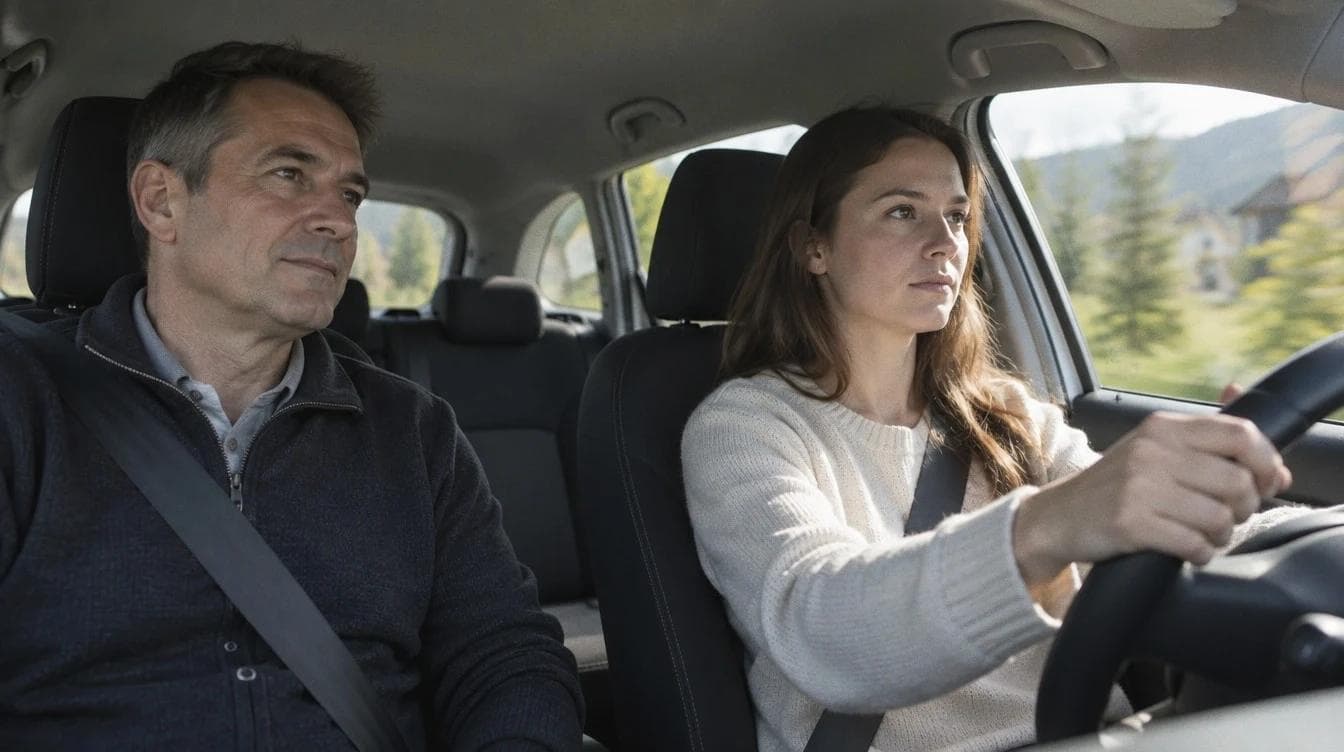
Arrive a quarter of an hour early. The examiner checks your identity, the documents, then the vehicle. He sometimes asks you to explain a control: lights, demisting, seat adjustment. Nothing insurmountable, but the answer must be clear.
Then, the road. The typical route alternates between several environments.
In town, he assesses your priorities, your observation, your positioning. Roundabouts count for a great deal: approach, choice of lane, indicator on exit, a look before moving off again. 30 km/h zones test the priority-to-the-right rule, a classic trap.
In manoeuvres, you will have a parking exercise: reversing into a bay, angled parking or parallel parking. The examiner looks at visual checks more than at the perfection of the positioning.
On open road, you drive at a limited speed on a faster route. Acceleration when passing the speed-limit change, the safety distance and the reading of anticipation are observed. If the route includes a mountain road, the handling of slopes and bends is added to the grid.
The total duration is around 45 to 60 minutes. At the end, the examiner announces the result on the spot, without unnecessary suspense. He justifies the decision, point by point. In the event of failure, a new registration is necessary, with its own fees and cantonal waiting times.
The pass rate varies by canton and period. Do not rely on a figure found on a forum: ask the cantonal authority for the statistics.

6. After the test: probationary licence and further training

If you pass, you receive a probationary driving licence, valid for three years. This is a federal rule, set out in the Road Traffic Act (LCR): it applies in all cantons.
The probationary licence demands strict discipline. If you commit a medium or serious offence during these three years, the licence is withdrawn and the probationary period is extended by one year. A second offence of the same kind leads to the cancellation of the licence, with the obligation to retake the test after a waiting period and an assessment.
During this period, you must complete the compulsory further training. It comprises two days of courses, the first within 12 months and the second no later than 3 years after obtaining the probationary licence. It is delivered by approved instructors, at a cost that varies depending on the organisation. Check the exact fee and dates before registering.
At the end of the three years, if the training is validated and your record is clean, you receive the definitive licence.
According to the Federal Roads Office (FEDRO, OFROU), the probationary driving licence is valid for three years and its conversion into a definitive licence requires the compulsory two-day further training, with no offence leading to withdrawal.

Pitfalls to avoid on test day

Here are the mistakes that examiners most often note, and that you can correct before the summons.
  • Blind spot poorly checked: a simple glance in the mirror is not enough. Turn your head, visibly.
  • Priority to the right in a 30 km/h zone: the candidate arrives too fast and brakes late. Anticipate, slow down early.
  • Acceleration when passing the speed-limit change: once past the sign, build up speed smoothly, but without exceeding the limit.
  • Non-compliant vehicle on the day: bald tyres, dirty plate, missing vignette. Check everything the day before.
  • Forgotten documents: learner's permit, identity document, proof of payment. Put them on the passenger seat first thing in the morning.
  • Cantonal comparison not verified: do not rely on the fees or waiting times of another canton. Consult your own canton's official page.
One last point, often underestimated: managing pressure. The candidate who verbalises his observations silently in his head drives more calmly. Breathe before starting the engine.

Checklist before booking the date

Before clicking "book", tick these five points.
  • Valid learner's permit, with the first-aid certificate attached to the file
  • Theory test passed and certificate kept
  • At least one recent series of lessons with your school, and clear feedback from your instructor on your level
  • Vehicle checked: tyres, brakes, plates, insurance, motorway vignette if necessary
  • Fees, charges and waiting times confirmed on the official website of the competent cantonal office
For Geneva, consult the test registration page directly on ge.ch. For Vaud, go to vd.ch. For the OCN (Neuchâtel, Fribourg, Jura), the procedure is described on ocn.ch. For Bern, see the SVSA website. Each page contains up-to-date fees and waiting times.
Once the date is set, drive in test conditions: same time of day, same type of route, with your instructor. A route you know by heart will make you less of a nervous candidate and more of a driver who anticipates.
"This article is provided for information purposes only and does not constitute legal advice; the requirements for the practical driving test may change, so we invite you to consult the official provisions and to contact the competent cantonal motor vehicle office."

FAQ

The category B practical test lasts on average 45 to 60 minutes. It takes place in real traffic, with an examiner on board, and includes town driving, parking manoeuvres and a section at limited speed.

The learner's permit costs about CHF 60 at cantonal level, but this amount varies by canton and may change. Check the exact fee on the SAN's official page before submitting your file.

A medium or serious offence during the probationary period leads to the withdrawal of the licence and an extension of the probationary period by one year. A second offence cancels the licence and requires a new test.

The Confederation imposes no minimum number of hours for category B. The field average is around 20 lessons, but this depends on your level, the supervised driving and the advice of your instructor.

Yes. The further training comprises two days of courses, to be completed within three years of obtaining the probationary licence. Without it, the definitive licence is not issued, even without any offence.

Automotoplus Background
Prepare your car before the test

A roadworthy, insured and well-maintained vehicle avoids unpleasant surprises on the day. Contact us for advice on your test car or your first purchase.

Author image

AutoMotoplus

Practical car driving test in French-speaking Switzerland: 6 steps to