Automotoplus Background
Voitour

The Swiss car market in 2026: what the figures really tell us

245,000 registrations, 23% electric, average price at CHF 52,000: the Swiss car market in 2026 in raw data to help you decide.

Automotoplus - The Swiss car market in 2026: what the figures really tell us

Introduction

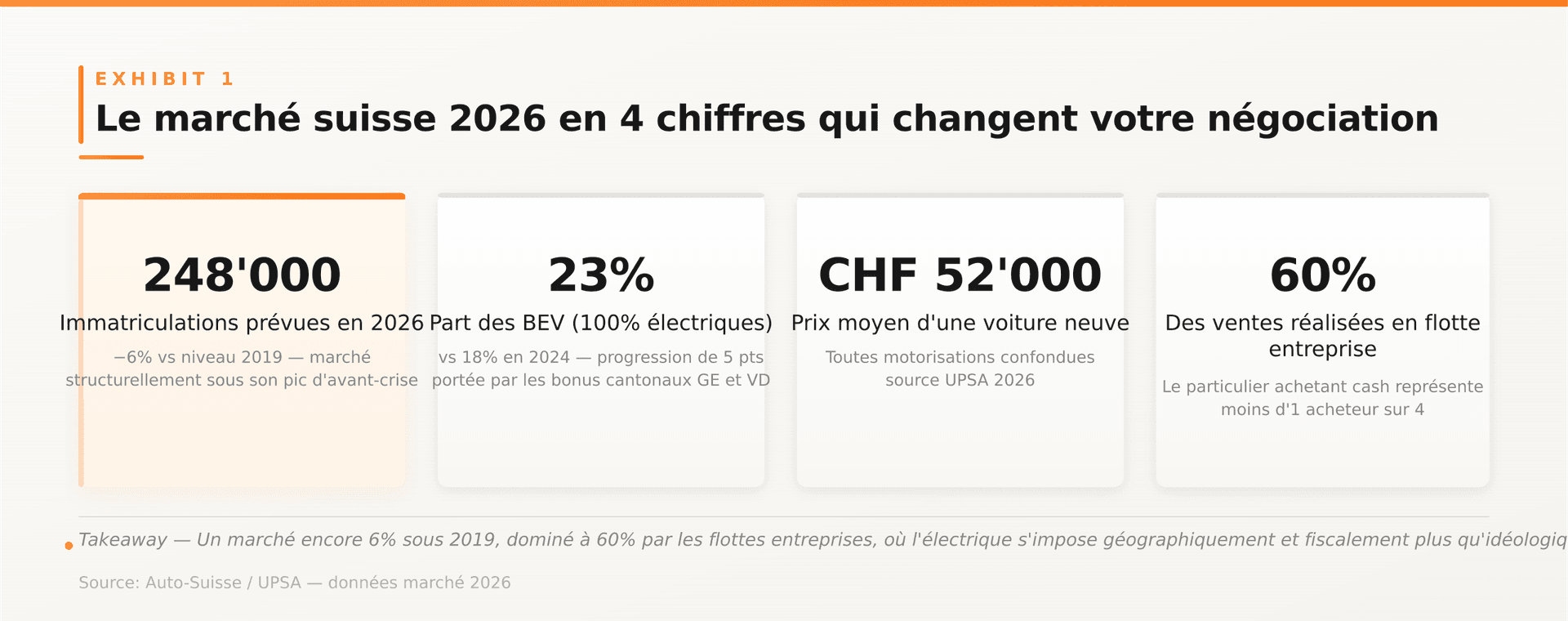
In 2026, Auto-Suisse projects 248,000 new car registrations on Swiss territory — the market remains 6% below its 2019 level, and no reputable dealer will tell you otherwise. The share of 100% electric vehicles (BEV) is approaching 23% of new registrations, compared with 18% in 2024. The average price of a new car now exceeds CHF 52,000 across all powertrains, according to UPSA [Union professionnelle suisse de l'automobile] data. In other words: you have a quote on the table, and this market concerns you directly.
The Swiss car market in 2026: what the figures really tell us — The Swiss market in 2026 in 4 figures that will change your negotiation
The Swiss car market in 2026: what the figures really tell us — The Swiss market in 2026 in 4 figures that will change your negotiation

How many new cars are sold, and who is really buying?

The 248,000 Swiss registrations in 2026 conceal a segmented reality. Approximately 60% of these sales are company fleet vehicles or leasing vehicles intended for businesses — the private buyer purchasing a new vehicle outright represents fewer than one in four buyers. SMEs with 3 to 10 fleet vehicles form the core of actual demand at dealerships in French-speaking Switzerland.
By category, compact SUVs account for 31% of Swiss registrations, according to Auto-Suisse. Traditional saloons continue their decline at 14%. Family estate cars — despite being popular in German-speaking Switzerland — have fallen below 9%. In Romandy, the C-segment SUV (Toyota C-HR, Honda ZR-V, Peugeot 3008) has dominated waiting lists at Geneva and Vaud dealerships since the start of 2026.
Who is buying? According to the Federal Statistical Office (OFS [Office fédéral de la statistique]), the typical new car buyer in Switzerland is 47 years old, has a net income above CHF 8,500/month, and renews their vehicle every 5.2 years on average. This profile explains why the trade-in bonus remains a central negotiating lever: your current vehicle has value, and dealerships short of used vehicle (VO [véhicules d'occasion]) stock know it.
If you are embarking on a structured buying process, the administrative steps — cantonal road traffic office, registration, third-party liability insurance — are worth planning in advance. A practical guide on how to buy a car in Switzerland sets out this process step by step.

Is the decline of diesel definitive or seasonal?

Diesel accounted for 28% of Swiss registrations in 2021. In 2026, that figure falls to 11%, according to Auto-Suisse data compiled by the UPSA. This is not a seasonal trough: it is a structural withdrawal accelerated by three simultaneous factors.
First factor: Euro 7 standards, applicable to new models since 2025, have pushed the cost of developing diesel powertrains up by 15 to 22% according to manufacturers' estimates. Volkswagen, Stellantis and Toyota have all announced the end of new diesel variants in their compact segments. Second factor: the cantonal motor vehicle tax on diesel vehicles remains heavier in several cantons of French-speaking Switzerland — in Geneva, the annual tax for a 2.0 diesel producing 150 kW exceeds CHF 800, compared with CHF 420 for a comparable plug-in hybrid. Third factor: the residual value of recent diesel vehicles has contracted by 8 percentage points over 24 months on the Swiss used vehicle market, which directly penalises residual leasing contracts based on a 36- or 48-month trade-in value.
One defensible niche remains: long-distance diesel use for annual mileages above 35,000 km, particularly for sales representatives and tradespeople in Alpine areas. Outside this profile, the TCO (total cost of ownership over 4 years) calculation no longer favours diesel over a full hybrid or a subsidised BEV.

Electric vehicles are growing, but at what real cost for a private?

23% BEV registrations in 2026: the figure is real, but it needs to be broken down. In Romandy, Vaud and Geneva together account for 26% of national electric registrations. The Geneva cantonal bonuses (up to CHF 6,000 for a new BEV under CHF 70,000) and Vaud bonuses (CHF 3,000, subject to income conditions) have mechanically accelerated local sales by 21% year on year. Conversely, Uri, Appenzell Innerrhoden and Obwalden offer no cantonal bonus-malus scheme: the BEV share there remains below 6% of registrations.
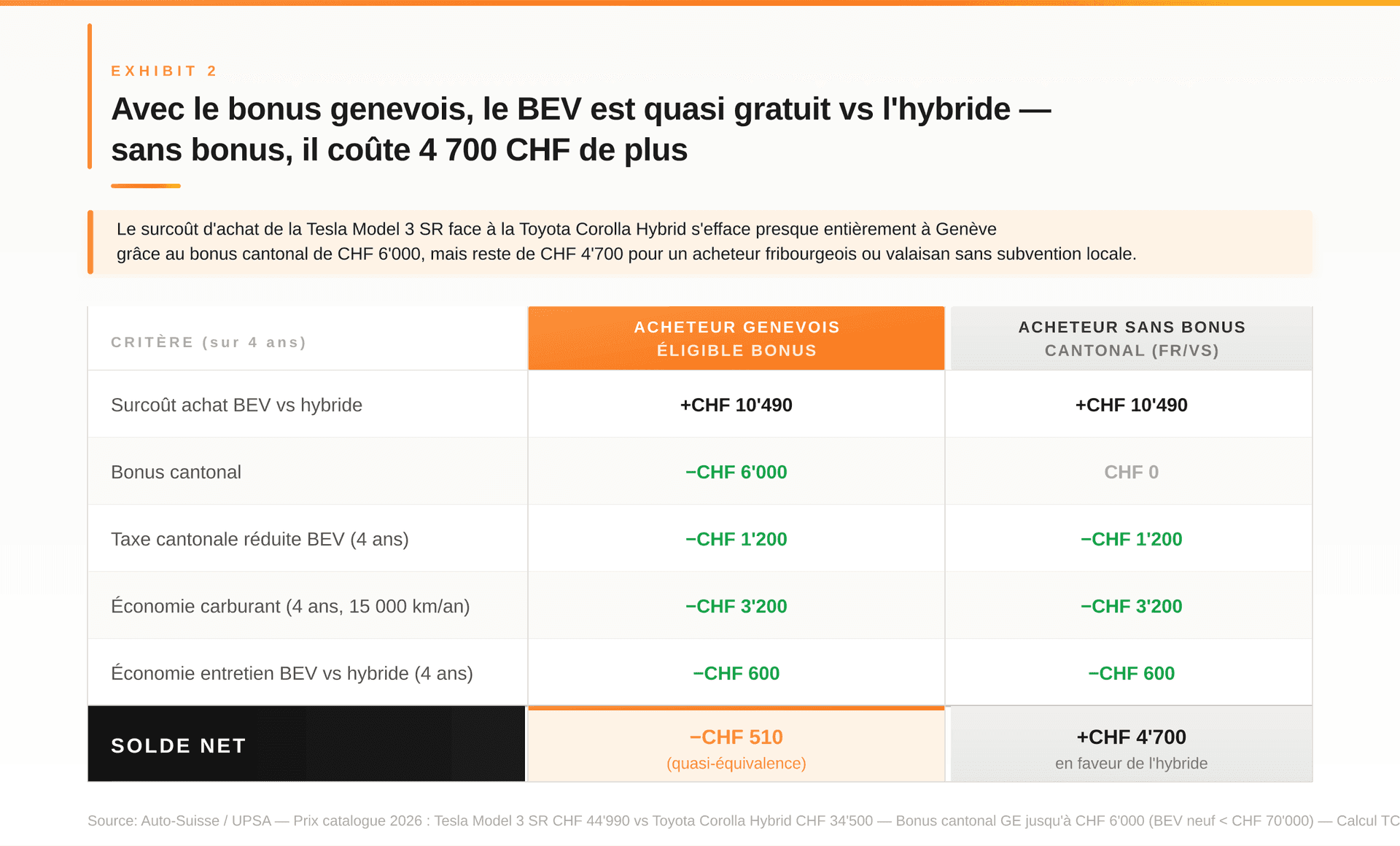
The straightforward calculation for a private buyer in French-speaking Switzerland over 4 years, taking a Tesla Model 3 Standard Range at CHF 44,990 (2026 list price) against a Toyota Corolla Hybrid at CHF 34,500:
  • BEV purchase premium: +CHF 10,490
  • Geneva cantonal bonus: -CHF 6,000 (if eligible)
  • Reduced cantonal tax BEV vs hybrid over 4 years: -CHF 1,200
  • Estimated fuel saving (15,000 km/year, home electricity at CHF 0.22/kWh): -CHF 3,200
  • BEV vs hybrid servicing over 4 years: -CHF 600
  • Net balance in favour of BEV (with Geneva bonus): approximately -CHF 510 — near-financial equivalence
Without a cantonal bonus (the case for a buyer in Fribourg or Valais with no local subsidy), the BEV remains CHF 4,700 more expensive over 4 years at equivalent usage. The decision is not ideological — it is geographical and fiscal.
For an SME with a fleet of 3 vehicles, the accelerated tax deduction on BEVs (depreciation over 2 years under cantonal tax law in several cantons of French-speaking Switzerland) may change the calculation. This should be verified with your fiduciary before any bulk order.
The Swiss car market in 2026: what the figures really tell us — With the Geneva bonus, the BEV is almost cost-neutral vs the hybrid — without a bonus, it costs

The Swiss car market in 2026: what the figures really tell us — With the Geneva bonus, the BEV is almost cost-neutral vs the hybrid — without a bonus, it costs

Is the Swiss used vehicle market holding up against new car price?

The used vehicle (VO) stock in Switzerland has been under unprecedented pressure since 2022. The scarcity of new cars during the semiconductor shortage drove used vehicle prices up by 18% between 2021 and 2023. In 2026, a partial correction is under way: used vehicle prices are falling by 4 to 7% depending on the segment, according to market data published by the UPSA.
But this correction is not uniform. Used electric vehicles under 3 years old are losing value faster than expected: a 2023 Tesla Model Y with 40,000 km is being traded at 28% below its original new price, compared with 20% for a petrol Golf 8 with the same mileage profile. The residual value of BEVs remains the main uncertainty for anyone considering a residual lease on a used electric vehicle.
For used vehicle buyers in Romandy, the best deals are currently to be found on 2022–2023 plug-in hybrids (PHEVs): company fleets are returning them en masse, the batteries are in their prime years, and dealerships are offering attractive trade-in bonuses to clear stock. A PHEV that cost CHF 50,000 new in 2023 can regularly be found for under CHF 32,000 in 2026 with remaining manufacturer's warranty.
Be mindful of the cantonal motor vehicle tax when buying a used vehicle: it is calculated on power output and sometimes weight, not on the age of the vehicle. A powerful PHEV can generate an annual tax identical to that of a new vehicle in certain cantons.

Leasing or outright purchase in 2026: what interest rates are doing

A residual lease at 49% over 48 months cost CHF 290/month in January 2022 for a CHF 35,000 vehicle; at the rates charged by leasing companies in 2026 (effective annual rate between 3.9% and 5.2% depending on the provider), the same structure exceeds CHF 370 per month — CHF 80 more for the same vehicle, without the residual value having moved by a single franc.
The Swiss National Bank has eased its monetary policy since late 2024, but car leasing rates have not followed at the same pace: the margins of manufacturers' financial captives remain high. In concrete terms, for a CHF 45,000 vehicle with a 10% deposit and a residual lease at 45% over 48 months:
  • Monthly payment at 2.9% rate (2022): approximately CHF 510
  • Monthly payment at 4.8% rate (2026): approximately CHF 590
  • Total additional cost over the contract: +CHF 3,840
Outright purchase becomes competitive again if you have liquid assets invested at less than 2.5% net: above that, the opportunity cost favours retaining liquidity and leasing. Below that, paying cash and negotiating a dealer discount of 3 to 5% (currently common on fast-moving new stock) remains the most economical strategy over 4 years.
For SMEs, leasing remains more fiscally advantageous than an on-balance-sheet purchase in most cantons of French-speaking Switzerland: the monthly payments are deductible as operating expenses, unlike depreciation, whose schedule is prescribed.

Which cantons buy the most, and what that means for negotiating

Vaud and Geneva together account for 22% of Swiss new car registrations, according to Auto-Suisse 2026. Zurich alone represents 18%. These three cantons therefore account for 40% of the national market — which means that dealerships in Romandy and Zurich operate in a high-volume, competitive market, with tighter margins but also larger stocks.
For you as a buyer in Romandy, this concentration is a direct negotiating lever: a Vaud or Geneva dealer sells 3 to 4 times more vehicles than a dealer in Uri. They have greater flexibility on discounts, included accessories, and above all trade-in bonuses on your current vehicle. A Geneva network selling 80 cars per month can offer CHF 1,500 to CHF 2,500 more on the trade-in of your existing vehicle than a small rural cantonal dealership, in order to maintain its volume.
Conversely, low-volume cantons (Uri, Glarus, Appenzell) sometimes offer shorter delivery times on popular models: the dealer has fewer orders in progress and more flexibility on manufacturer allocations. If delivery time is your priority and you are able to travel, geographical arbitrage is worth considering.
The cantonal motor vehicle tax varies by a factor of two between cantons: Geneva levies a heavy tax on powerful combustion-engine vehicles, while Nidwalden is one of the cheapest cantons. If you register a company vehicle in a canton different from your registered office, the legality of this arrangement should be verified with the relevant cantonal road traffic office.
To compare two specific models in this Romandy market — particularly in the compact SUV segment that dominates sales — the Toyota C-HR vs Honda ZR-V comparison illustrates well how differences in engine displacement and power output affect the annual cantonal tax in Vaud or Geneva.

Conclusion: three concrete steps before you sign

The Swiss market in 2026 favours the informed buyer: abundant used vehicle stock on PHEVs, dealerships under volume pressure in Romandy, and negotiable trade-in bonuses if you arrive with your used vehicle valuation in hand. First calculate your TCO over 4 years powertrain by powertrain — diesel excluded except for high mileages — before opening any discussion on monthly payments. Compare the cantonal bonuses available in your canton before choosing between a new and a used electric vehicle: on a Geneva purchase, CHF 6,000 of subsidy changes the calculation in under ten minutes of arithmetic.
"The information contained in this article is provided for purely informational purposes and reflects the data available at the time of publication. It does not constitute legal or commercial advice. automotoplus.ch accepts no liability for the accuracy of Swiss car market data."

FAQ

Auto-Suisse projects approximately 248,000 new car registrations in 2026, a level still 6% below the pre-Covid figures of 2019. Company fleets account for approximately 60% of these purchases.

BEVs (100% electric vehicles) account for approximately 23% of new registrations in Switzerland in 2026. This share rises to 26% of national BEV registrations concentrated in the cantons of Vaud and Geneva alone, thanks to local cantonal bonuses of up to CHF 6,000.

Diesel now accounts for only 11% of Swiss registrations in 2026, compared with 28% in 2021. It remains relevant only for annual mileages above 35,000 km. Below that, the higher cantonal tax and contracting residual value penalise the TCO calculation over 4 years.

For a CHF 45,000 vehicle with a 10% deposit and a residual lease at 45% over 48 months, the monthly payment has risen from approximately CHF 510 in 2022 (rate of 2.9%) to approximately CHF 590 in 2026 (rate of 4.8%), representing a total additional cost of CHF 3,840 over the duration of the contract.

Geneva offers up to CHF 6,000 in cantonal bonus for a new BEV under CHF 70,000. Vaud offers CHF 3,000 subject to income conditions. Several cantons such as Uri, Nidwalden and Appenzell offer no cantonal bonus-malus scheme, which fundamentally changes the TCO calculation depending on your place of residence.

The Swiss used vehicle market is correcting by 4 to 7% in 2026 following the rises of 2021–2023. PHEVs from 2022–2023 returned by fleets offer the best value-to-remaining-warranty ratio. A PHEV that cost CHF 50,000 new in 2023 can regularly be found for under CHF 32,000 in 2026 with the manufacturer's warranty still active.

Author image

AutoMotoplus

The Swiss car market in 2026: what the figures really tell us