Categories B, A, A1, M, BE, C1 and D1: who drives what
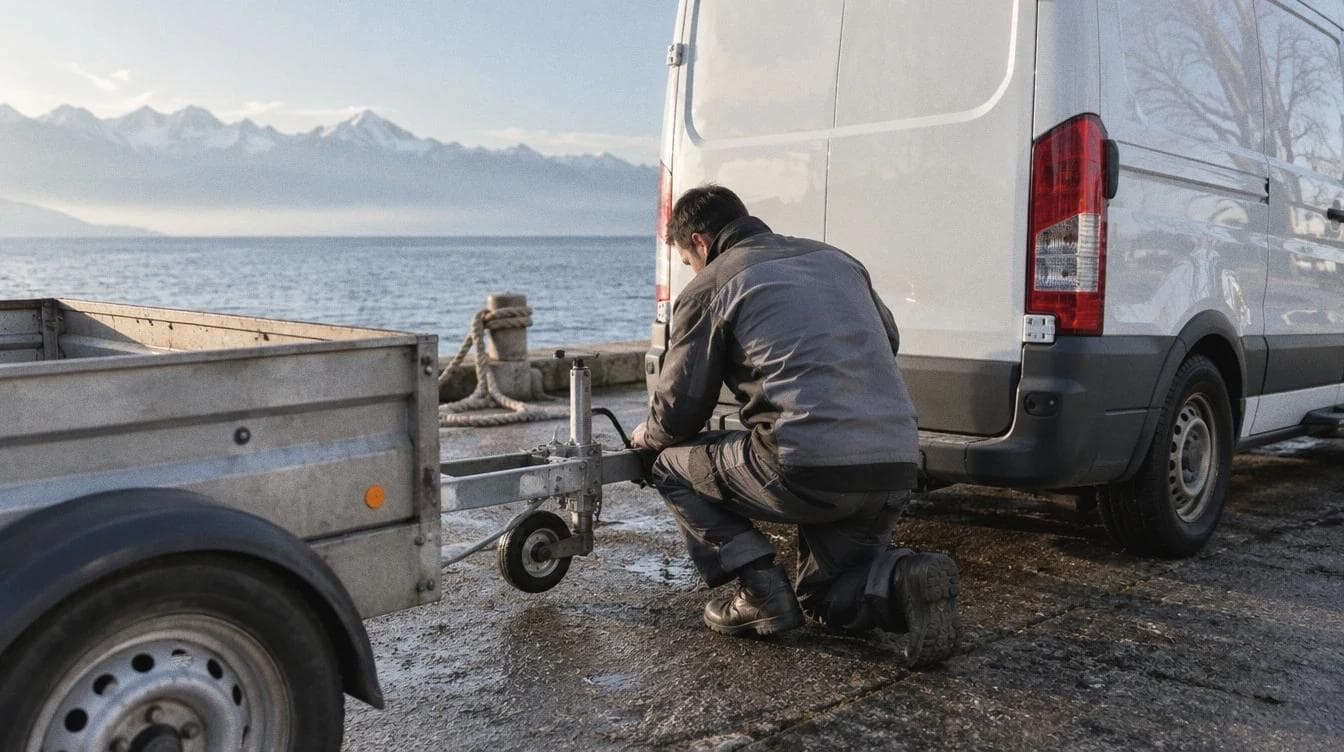
A tradesman in Lausanne signs a lease for a 3.5 t van and hitches up his 1.5 t tool trailer. On paper, everything looks fine. On the road, he is driving outside his licence category. To avoid this scenario, let us start with the basic framework, laid down by the Ordinance on Admission to Road Traffic (OAC).
Category B: cars and vans up to 3500 kg gross weight, with a maximum of eight seats in addition to the driver, minimum age 18. It permits a trailer of up to 750 kg. It also permits a heavier trailer, provided that the combination does not exceed 3500 kg.
Category BE: B plus a trailer whose gross weight exceeds this limit. The weight of the trailer is limited to 3500 kg, according to the OAC. Essential for the family towing a large caravan.
Category C1: vehicles from 3500 to 7500 kg. Minimum age 18. This is the key for large motorhomes and light delivery lorries.
Category D1: minibuses with nine to sixteen seats, driver included, with a maximum length of eight metres. Minimum age 21. Note: the professional carriage of passengers also requires a specific authorisation (professional driving licence).
On the two-wheeler side: category A covers all motorcycles, with direct access from age 25 or progressive access from age 18. A1 is for motorcycles up to 11 kW. Category M covers mopeds up to 45 km/h, from age 14. For details of the motorcycle route, see our guide to the motorcycle licence in Switzerland: categories, costs in CHF and steps from A to Z.
According to the Ordinance on Admission to Road Traffic (OAC), category B permits vehicles up to 3500 kg gross weight, with a maximum of eight seats in addition to the driver, from the age of 18.
Workshop tip: take out your licence, find the categories printed on the back and compare them with the gross weight of your vehicle. Five minutes, no surprises.
A 19-year-old in Fribourg has just passed his test. He buys a second-hand city car, then is caught on camera 30 km/h over the limit in a built-up area. Possible outcome: withdrawal of the licence, and starting the whole process again from scratch.
The rule in plain terms: the category B driving licence is first issued on probation for three years. This period runs from passing the practical test. During this period, a medium or serious offence results in withdrawal of the licence, with the Road Traffic Act (LCR) providing in this case for the cancellation of the probationary period. The driver must then repeat the whole process: course, theory and practical tests, with the probationary period extended to four years.
Withdrawal of a probationary licence is therefore more severe than a simple ordinary withdrawal. One must count the costs of retraining, the loss of mobility and, for a young person who works shifts or travels for work, a direct risk to employment.
The further training course is compulsory: it is divided into two one-day modules. The first is to be taken between the sixth and twelfth month after obtaining the licence, the second between the twelfth and twenty-fourth month. To be checked with the motor vehicle office of your canton, which sends reminders of the deadlines.
According to the LCR, the probationary driving licence is valid for three years. A medium or serious offence during this period results in its withdrawal and in the whole process being repeated, with an extended probationary period.
Workshop tip: before choosing the city car, budget for a safety cushion. Also put two dates in your diary for the further training modules. For test preparation, our article on the practical car test in French-speaking Switzerland in 6 steps will help you.
Van, motorhome, trailer: the 3.5-tonne pitfall
A family in Sion buys a 4.2 t motorhome because the advertisement said "B licence sufficient". Mistake: above 3500 kg gross weight, category C1 becomes compulsory. Police check, vehicle impounded, holiday cancelled.
The rule: what counts is the maximum authorised weight (gross vehicle weight), shown on the vehicle's registration document. Not the unladen weight, not the actual weight when weighed loaded. For a combination, one adds the gross weights of the towing vehicle and the trailer, or looks at each one according to the chosen combination.
Three typical situations:
Car with a gross weight of 1800 kg with a 700 kg trailer: category B is sufficient.
Van of 3500 kg with a 1500 kg trailer: B is no longer enough, BE is needed.
Motorhome with a gross weight of 4200 kg: C1 is needed, with or without a trailer depending on the combination.
Code 96 is the intermediate option. It is added to category B after specific training and a practical test, and it permits towing a trailer exceeding 750 kg if the combination remains between 3500 and 4250 kg. It is often a faster route than a full BE course.
According to the OAC, category B is limited to 3500 kg gross weight. Beyond that, at least code 96 is needed for a combination of up to 4250 kg, or category BE or C1 depending on the combination.
On the leasing side: a van that turns out to be off-limits to its own driver quickly loses its residual value. Check the combined gross weight before signing, not after the first police check.
Workshop tip: ask yourself three questions. What is my gross weight? What is the trailer's? Which category is printed on my licence? If an answer is missing, call your canton's motor vehicle office.
Taking or changing category: process, costs and timescales
A self-employed person in Neuchâtel wants to add category C1 to deliver materials with a 7.5 t lorry. How long, how many CHF, which steps? Here is the typical process, to be confirmed with your canton's motor vehicle office.
Step 1: the file. Application form, photo, eyesight test certificate and, for heavy categories (C1, D1), a medical check. Cantonal file fees vary from one canton to another (VD, GE, FR, VS, NE, JU).
Step 2: the theory. Theory test for the categories that require it. Allow CHF 30 to 70 in test fees, depending on the canton (indicative range for 2026, to be verified).
Step 3: the lessons. A driving lesson in a car costs around CHF 90 to 110 (indicative range for 2026). For C1, lessons on a heavy goods vehicle cost considerably more, in the order of CHF 150 to 200 per hour. The number of lessons depends on experience: around ten for C1 is a common order of magnitude.
Step 4: the practical test. The motor vehicle office's fee is generally between CHF 100 and 200 for category B and rises for C1 and BE (to be verified, canton by canton).
Timescales: four to twelve weeks between submitting the file and the test, depending on the canton and the season. The definitive licence arrives by post a few days to a few weeks after passing.
Test fees vary from one canton to another: consult the official tariff of the motor vehicle office of your canton of residence before planning your budget.
Workshop tip: book the medical check at the same time as submitting the file. It is often the link that delays everything. For a complete overview, also read our guide to the Führerschein in Switzerland: everything you need to know about your licence.
Exchanging a foreign licence and validity of the Swiss licence
An employee arrives in Geneva from Lyon with her French licence. She thinks she can drive on it indefinitely. She is mistaken: deadlines apply.
The basic rule: a foreign licence is valid in Switzerland for tourists. For a resident, it must be exchanged at the canton's motor vehicle office. The exchange deadline for EU or EFTA licences is in principle twelve months after taking up residence. For other countries, the validity period is shorter and a practical test, sometimes a theory test, may be required. Check the exact rule for your canton and your country of origin before exceeding the deadlines (to be confirmed with the motor vehicle office).
On validity, the Swiss driving licence is valid until the renewal date set by law: the current card format must be renewed on a date shown on the licence. Heavy categories (C1, D1) require a regular medical check, according to the OAC, with a shorter interval from age 50.
From age 75, all car drivers are subject to a medical check every two years, carried out by a doctor recognised by the canton. According to the OAC, this check is compulsory from the age of 75. The result is sent to the motor vehicle office.
To go further into the conditions, costs and exchange, see our dossier on the Swiss driving licence: conditions, costs and exchange. And for a newcomer who also needs to find out about insurance, take a look at car insurance without a licence in Switzerland.
Workshop tip: note the date of your arrival in Switzerland and set a reminder at ten months. This leaves time to put the file together before the cantonal deadline.
Three typical cases with budgets in CHF
The amounts below are indicative orders of magnitude for 2026. They vary from one canton to another (VD, GE, FR, VS, NE, JU). Ask the motor vehicle office of your canton of residence for the exact amount.
Case 1: the tradesman with a van. He owns a 3500 kg van and a 1500 kg trailer. He takes category BE. Estimated budget: approximately CHF 800 to 1500 in total (a few lessons, test fees, file check). If he works with an occasional combination, code 96 can reduce the bill. Risk avoided: a site stoppage of several days in the event of a check.
Case 2: the family with a caravan. A 1700 kg car tows a 1300 kg caravan. The combination exceeds 3000 kg but remains under 4250 kg. Code 96 is the fastest route: training and test with a budget generally around CHF 400 to 900 (indicative, to be verified). The family avoids a full BE course.
Case 3: the young driver. A person aged 18 takes category B. Indicative budget: CHF 2500 to 3500 for the whole process. This includes the awareness course, lessons, theory and practical test. The two compulsory further training modules during the probationary period are added to the bill. This budget needs to be prepared before buying the city car, not after.
For an overview of traffic rules and penalties, our article driving in Switzerland: rules, fines and tips gives you the full context.
Workshop tip: ask for two or three quotes from driving schools before you start. The difference between two schools in the same region can exceed CHF 500 over a full course.
"The information presented in this article is provided for information purposes only and does not constitute legal advice; as the conditions for obtaining driving licence categories may change, we invite you to consult the cantonal road traffic office or the competent authorities for any personal situation."
FAQ
A 4.2 t motorhome exceeds the 3500 kg limit of category B. Category C1 is needed, valid from 3500 to 7500 kg. Check the gross vehicle weight on the registration document before purchase.
Code 96 is added to category B after training and a test. It permits towing a trailer exceeding 750 kg when the combination is between 3500 and 4250 kg. It is a faster alternative to category BE.
A withdrawal during the three-year probationary period means repeating the whole process: course, theory and practical. The probationary period is also extended. These costs and the loss of mobility need to be budgeted for.
For an EU or EFTA licence, the exchange takes place in principle within twelve months of taking up residence. For other countries, the deadlines are shorter and a test may be required. Confirm with the cantonal motor vehicle office.
From age 75, drivers must undergo a medical check every two years. It is carried out by a doctor recognised by the canton, who sends the result to the motor vehicle office.
Is your combination compliant with your licence?
Contact us to check the gross weight of your van, motorhome or trailer before signing a lease or taking to the road.