In most countries, car insurance is routine paperwork. You buy a policy, upload a document, and move on. In Switzerland, it works completely differently — your insurance is the legal key to getting license plates on your vehicle. No valid coverage, no plates. No plates, no driving. Full stop.
The Swiss system runs on three distinct coverage tiers: one mandatory, two optional. Most new arrivals assume the cheapest option is fine — and then discover too late that their own car is completely unprotected. Understanding how the three tiers work, what the deductible means in practice, and how the bonus-malus system adjusts what you pay each year will help you choose the right policy from day one.
Here is everything you need to know about how car insurance works in Switzerland in 2026.
Why Car Insurance Is Mandatory in Switzerland
Swiss federal law — the Road Traffic Act (Strassenverkehrsgesetz / SVG) — requires every vehicle owner to hold valid third-party liability insurance before the vehicle can be registered. Without proof of coverage, the cantonal road traffic office will not issue license plates. The vehicle cannot legally be driven.
The consequences of letting that coverage lapse are just as serious. If your policy lapses while your vehicle is still registered, your insurer is legally required to notify the road traffic office. The office can confiscate your plates on the spot — and will not reinstate them until you can show active coverage again.
Driving uninsured in Switzerland carries heavy fines and leaves you personally liable for any damage you cause — with no cap, no ceiling, and no limit. Property damage, medical bills, lost income for injured parties — all of that falls on you, personally.
This applies across all vehicle types: cars, motorcycles, campervans, and trailers. If it needs a registration number, it needs insurance first.
Notes for Expats and New Arrivals
The moment you register a foreign vehicle in Switzerland — or purchase one locally — insurance is step one, not a follow-up task. Get a quote before you register your vehicle, so you have proof of coverage in hand when you walk into the cantonal road traffic office (ASTRA).
The Three Types of Car Insurance in Switzerland
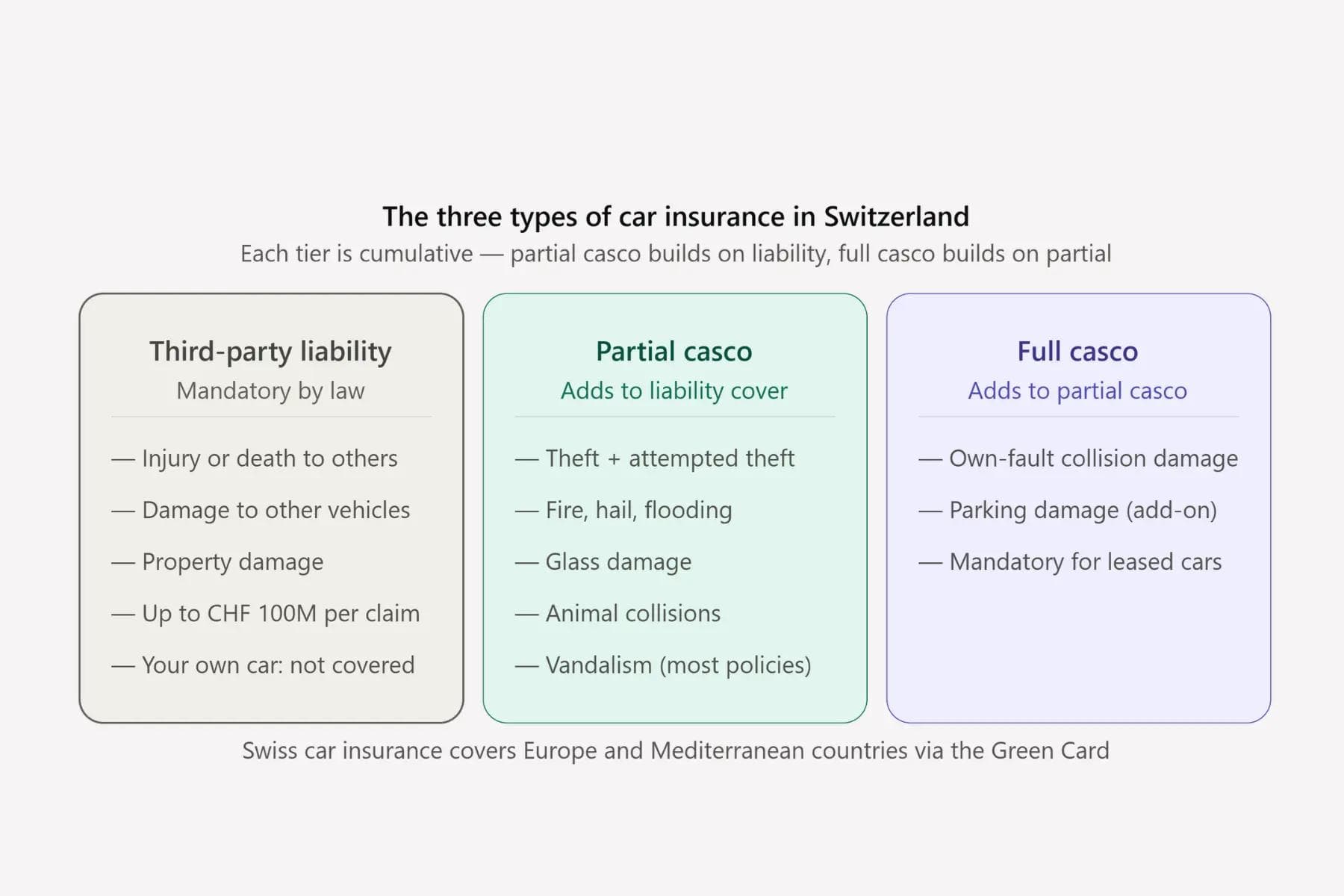
The Swiss system splits car insurance into three distinct levels. Only one is mandatory. Which optional covers make sense for you depends on your car's age, its current value, and how you use it.
The breakdown below maps each tier to what it actually protects — and what it leaves exposed.
Types of Swiss car insurance
Third-Party Liability (Haftpflicht / RC)
Third-party liability is the only mandatory type of car insurance in Switzerland. It covers all damage and injuries you cause to other people — other vehicles, property, pedestrians, and passengers in other cars. What it does not cover is anything that happens to your own vehicle.
The legal minimum cover is CHF 5 million per incident for a passenger car (Motor Vehicle Insurance Ordinance); in practice, Swiss policies commonly insure up to CHF 100 million. Those sums reflect how quickly serious accident costs compound: long-term medical care, disability payouts, and major property claims can escalate far beyond what most people expect.
The premium for third-party liability is the lowest of the three tiers, which leads many drivers to treat it as a default. Just know: if your car is stolen, damaged by a hailstorm, or you drive it into a wall — a third-party liability covers none of it.
Partial Casco (Teilkasko)
A partial casco is optional, but it is widely recommended for any car under eight years old. It covers damage to your own vehicle from events you did not cause and could not prevent:
Natural hazards: hail, flooding, storms, rockslides, and avalanches
Glass breakage
Animal collisions — including rodents chewing through wiring (more common than you'd think in rural Switzerland)
Vandalism — covered by most policies
Partial casco does not cover collision damage you cause yourself. That is where full casco comes in.
Many partial casco policies include roadside assistance or offer it as a bundled add-on. If you do not hold TCS (Touring Club Switzerland) membership or a separate breakdown policy, this is worth including — breaking down on an Alpine pass is not the moment to discover you have no coverage.
Full Casco (Vollkasko)
A full casco combines everything in a partial casco with collision cover. It protects your own vehicle when you are at fault, rear-ending another car, clipping a bollard, or sliding off an icy road in January.
Parking damage caused by unknown third parties — the driver who reverses into your door and leaves — is often available as a full casco add-on, typically covering up to CHF 1,000 per claim.
The full casco is generally mandatory for leased vehicles. Swiss leasing companies require it as a standard condition of any lease agreement.
What do Swiss insurance brokers advise?
For owned vehicles, most Swiss insurance brokers recommend keeping full casco for the first five to six years. Then, they reassess once the car has depreciated enough that the repair economics no longer add up.
Comprehensive Car Insurance in Switzerland
The Swiss equivalent is a full casco (Vollkasko). It is the broadest tier available, combining partial casco coverage with collision protection for damage you cause to your own vehicle. If you are comparing Swiss coverage to international equivalents, full casco is the closest match to what is called "comprehensive" or "full coverage car insurance" in other markets.
The Green Card: Your Coverage Across Europe
Every Swiss car insurance policy includes a Green Card, the international certificate of motor insurance. This extends your coverage across Europe and to countries bordering the Mediterranean, including Morocco and Turkey. Switzerland is not an EU member, but it is fully part of the Green Card system. You do not need to buy a separate temporary cover when driving abroad. Keep the card in your vehicle every time you cross the border.
What Does Car Insurance Cover? Common Exclusions to Know
Even a full casco policy does not cover everything. Knowing the exclusions upfront saves expensive surprises later.
What is covered?
What is not covered?
Third-party injuries and property damage (all tiers)
Personal belongings stolen from inside the vehicle
European coverage via Green Card (all tiers)
What is not covered?
Collision damage you cause — partial casco only
What Is and Is Not Covered Across Each Tier
A few additional points worth knowing:
Partial casco does not cover collision damage you cause to your own car. If you want that, you need a full casco.
Full casco does not cover damage caused by the other driver's fault, which falls under their third-party liability policy.
Optional Add-Ons Worth Adding to Your Policy
Swiss car insurance policies allow substantial customisation. The add-ons that make sense depend on your situation — not every driver needs all of them.
Worth Adding for Most Drivers
1. Gross negligence cover
This one surprises a lot of drivers. Without it, your insurer can seek financial recourse from you personally if an accident was caused by a preventable mistake — running a red light, speeding, or using your phone at the wheel. With this add-on, the insurer absorbs that cost. It is highly recommended across all policy types and is one of the most overlooked pieces of Swiss car insurance.
2. Roadside assistance/breakdown cover
The coverage is often partially included in partial casco, but coverage limits vary widely between insurers. If you do not hold a TCS membership or a standalone breakdown policy, this is worth confirming explicitly. Do not assume it is included — check the actual limits in your policy documents.
3. Bonus protection
After building several years of no-claims discount, this add-on protects your bonus level after one at-fault claim per observation period. If you have a strong and clean record, the annual cost of this add-on is usually far less than losing years of built-up discount.
Situational Add-Ons
1. Legal protection
It covers legal costs from disputes arising out of road incidents. Useful, but check first whether you already hold this under a household or separate legal protection policy. Doubling up is a common and unnecessary expense.
2. Parking damage
It covers scratches and dents caused by unknown third parties while your car is parked. Available under full casco, typically up to CHF 1,000 per claim. Worth adding if you park regularly in tight urban areas.
3. Replacement vehicle
It covers a hire car while your vehicle is being repaired after a claim. Essential if you rely on your car for work and cannot simply take public transport for two weeks.
4. Passenger accident insurance
It is generally not necessary for Swiss residents, who are already covered for accidents through their employer's accident insurance and the Swiss health system. Only consider this if you regularly carry passengers who are not covered under Swiss mandatory schemes — for example, visitors from non-European countries.
The Bonus-Malus System: How Claims Affect What You Pay
Swiss car insurance uses a bonus-malus system (BMS) to reward safe drivers — and to recover costs from those who make frequent claims.
Bonus: Each claim-free year earns a discount on your premium, typically around 5% per year with standard insurers, up to a maximum discount of approximately 35%. Some Swiss insurers extend that maximum to 70% off the base premium for long-term, clean-record customers.
Malus: An at-fault accident triggers a 20% premium surcharge in the following year. On average, it takes around five years of clean driving to return to your pre-accident premium level. That is a long tail, which is why the bonus protection add-on exists.
The BMS applies separately to each module. Your third-party liability bonus and your casco bonus are tracked independently. A theft claim on your partial casco does not touch your liability bonus, and vice versa.
Important detail
Swiss insurers use observation periods, not straight calendar years, to track claims. Two incidents in the same calendar year can fall into different observation windows depending on your insurer's policy year dates — and that affects how the malus is applied. It is worth clarifying this with your insurer if you have had multiple incidents.
The trade-off is simple: a higher deductible means a lower annual premium. A lower deductible means a higher premium but less personal cost when something goes wrong.
Scenario
Typical Deductible
Standard partial casco
CHF 300–500
Full casco (insurer-approved repair workshop)
From CHF 250
Young drivers (under 25)
Standard excess + CHF 1,000 surcharge
New licence holders (under 2 years)
Standard excess + CHF 1,000 surcharge
Standard partial casco
Typical Deductible
CHF 300–500
Full casco (insurer-approved repair workshop)
Typical Deductible
From CHF 250
Young drivers (under 25)
Typical Deductible
Standard excess + CHF 1,000 surcharge
New licence holders (under 2 years)
Typical Deductible
Standard excess + CHF 1,000 surcharge
Typical Deductible Ranges in Switzerland
The deductibles for partial casco and full casco are tracked and applied completely separately. A glass claim under partial casco and a collision claim under full casco each carry their own deductible — they do not combine.
Practical guidance
A higher deductible makes financial sense if you have a solid claims-free record and several years of bonuses built up. A lower deductible is the better choice if you are new to Swiss roads, drive frequently in high-traffic cities, or are still building confidence in winter driving conditions where small incidents are more common. There is no universally right answer — it depends on your risk tolerance and driving history.
How to Match Coverage to Your Vehicle's Age
The right insurance level is not fixed forever. It should change as your car ages, and its market value falls. Paying full casco premiums on a 12-year-old car rarely makes financial sense — the annual cost can approach or exceed what the insurer would actually pay out in a total loss.
Here is how Swiss insurance professionals generally frame the decision:
Vehicle Age
Recommended Coverage
0–5 years
Full casco + partial casco
5–8 years
Consider switching to partial casco only
8+ years
Third-party liability, evaluate partial casco need
Any age (leased)
Full casco mandatory
0–5 years
Recommended Coverage
Full casco + partial casco
5–8 years
Recommended Coverage
Consider switching to partial casco only
8+ years
Recommended Coverage
Third-party liability, evaluate partial casco need
Any age (leased)
Recommended Coverage
Full casco mandatory
Coverage for vehicle age
A full casco is designed to cover repair costs for your own vehicle. Once a car depreciates to the point where a repair bill could match or exceed its current market value, full casco stops making financial sense. Total loss payouts are based on the current market value at the time of the claim — not what you originally paid for the car.
Current value supplement: Some Swiss policies include a current value supplement for newer vehicles, which tops up a total loss payout to exceed the straight-line depreciated market value. If your car is new or nearly new, check whether your policy includes this, it is a meaningful difference in a write-off scenario.
Electric vehicles: A growing number of Swiss insurers now offer EV-specific policies covering battery damage, charging cable theft, and home or mobile charging equipment damage. If you drive an EV, it is worth comparing standard and EV-tailored policies side by side rather than defaulting to a standard policy that may leave gaps in EV-specific scenarios.
AutoMotoPlus connects you with trusted Swiss insurers so you can compare personalised offers in minutes. No guesswork, no paperwork maze.
Conclusion
Swiss car insurance is more layered than most people expect. But once you understand the three tiers, how the franchise works, and what the bonus-malus system means for your costs year on year — the decisions become clear.
The right policy depends on your car's age, its current value, and how and where you drive. Underinsuring leaves your vehicle exposed. Overinsuring means paying for cover that will never pay out more than your car is worth.